Compute, Power and Infrastructure Constraints Explained
For much of the past two years, discussions around AI have been dominated by possibility.
What models might achieve. What productivity gains could follow. What advantage might accrue to those who move first?
More recently, the conversation has shifted. In meetings and programme reviews, the constraint I see most often is not ambition or intent, but delivery.
Organisations are discovering that AI is not simply a software problem to be solved, but an infrastructure challenge that cuts across compute, power, facilities, and time.
This is not a transient mismatch. It represents a more fundamental shift in how AI needs to be planned and executed.
From AI strategy to delivery realism
Most organisations did not expect AI to scale as quickly, or as intensively, as it has.
What began as a tooling or platform discussion has evolved into a set of more foundational questions:
- Where does our compute actually come from?
- How predictable is access to it over the life of a programme?
- Which assumptions underpin our delivery plans?
- And which of those assumptions are no longer holding?
These questions don’t always appear in abstract strategy documents.
They tend to emerge through missed milestones, repeated replanning exercises, and projects quietly changing their scope.
The underlying driver is straightforward. Demand for AI capability is currently growing faster than the capacity of the systems designed to support it.
At the same time, power (most often the grid’s ability to deliver it), particularly in established markets, is becoming a hard constraint on what can be delivered and when.
Compute scarcity is rarely absolute
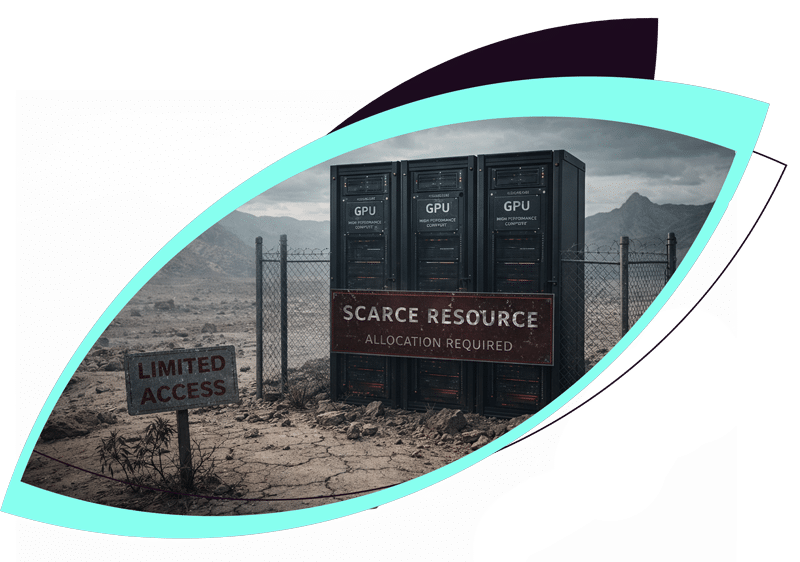 It is worth being precise about what this does and does not mean. This is not a story of compute being entirely unobtainable.
In some areas, supply has improved and lead times have eased from the peak of what we have seen more recently.
But compute is now, even more than before, seen as a strategic need, and access to frontier compute is highly contested.
As more capacity is concentrated in the hands of those organisations who are buying at scale, we are seeing a shift in pricing to reflect that control.
Access is shaped less by headline specifications and more by timing, commitment, energy availability, cooling capability, and the ability to operate infrastructure at extreme scale.
In practice, organisations are competing not just for hardware, but for environments that can be deployed into, integrated, and operated reliably.
A platform on a roadmap is not capacity unless it can be powered, cooled, connected, and supported.
Power has moved from operational detail to strategic constraint
Over the last year, energy has shifted from the background to the foreground of AI delivery discussions.
AI optimised infrastructure places fundamentally different demands on power and cooling than traditional HPC workloads.
Grid reinforcement, connection, and planning processes, however, often operate on multiyear timelines particularly in mature hubs where demand is already concentrated.
The result is a growing mismatch: infrastructure that can be specified and funded faster than it can realistically be connected and operated.
For many leadership teams, this is unfamiliar territory. Energy has historically been treated as an operational concern. It is now a strategic one.
AI delivery increasingly sits at the intersection of technology strategy, estates planning, energy procurement, and long term capital allocation.
That level of coordination is not optional, and for many organisations, it is new.
Time is your adversary
Even where budgets exist and intent is strong, delivery timelines are stretching.
 AI and HPC programmes expose dependencies running in parallel:
- Procurement and supply chains
- Facility readiness
- Power and cooling upgrades
- Network integration
- Operational capability
In isolation, each is usually manageable, but timescales for all of these elements are being stretched beyond the usual metrics. Put them together, and they remove any slack.
This is why many programmes experience repeated replanning. Previously safe assumptions made early rarely survive contact with the current delivery reality.
The impact is not usually visible as immediate failure; it shows up as drift, delay, and loss of momentum. And time is not just a project issue it is a strategic one.
What is different where progress is being made
Where organisations are navigating this successfully, a few patterns are emerging.
The strongest programmes are explicitly constraint led. Compute, power, and time are treated as design inputs from the outset, not problems to be solved later.
They are selective, prioritising workloads based on value and deliverability rather than technical novelty alone.
They preserve optionality, avoiding irreversible commitments in areas where future availability remains uncertain.
And they value independence. Vendor roadmaps are useful signals, but they are not delivery guarantees.
Neutral, system level advice early in a programme often preserves choice later. These are organisational advantages rather than technological ones.
The next phase: realism rather than relief
There is little evidence of a rapid return to abundance. Some constraints will ease; others will replace them.
Power availability, site readiness, and delivery capability will increasingly determine where AI can scale, not simply where it is most desired.
The organisations that navigate the next two years well will be those that align ambition to capacity, make fewer irreversible decisions, and invest early in clarity.
In this environment, thoughtful restraint often outperforms speed.
A final thought
 AI will continue to reshape research, industry, and public services. But its progress will be shaped less by what models can do, and more by who can deliver them reliably and sustainably.
This is an infrastructure decade. Success will belong to organisations that understand the system around AI, not just the technology itself.
At Red Oak, we don’t sell platforms or shortcuts. Our role is to help organisations understand delivery reality early, so that decisions made today still make sense tomorrow.
If this reflects what you’re seeing, the conversation is worth having.

Dairsie Latimer
Technology Fellow
Red Oak Consulting