Reducing Risk and Maximising Performance
High‑Performance Computing (HPC) environments never sit quietly.
Workloads grow, AI models get hungrier, research expands, and expectations climb. Meanwhile, infrastructure ages gracefully… or not so gracefully. And through all this, someone, somewhere, is expected to “just keep the cluster running.” Easy, right?
Spoiler: it’s not.
In many organisations, that responsibility lands on a tiny team juggling everything from system admin to “why is the queue suddenly behaving like a diva?” troubleshooting.
HPC isn’t standard IT. It’s fast, complex and occasionally dramatic, a high‑performance ecosystem built to drive research, engineering and AI outcomes. When it falters, everything built on top of it falters as well.
That’s why HPC Managed Services shouldn’t just be reactive support.
They should be strategic, structured and aligned to what the organisation actually needs to achieve.
Why HPC Needs More Than Traditional IT Support
Traditional IT support focuses on uptime and fixing tickets.

HPC environments? They demand a lot more love.
- Performance tuning (because default settings are for optimists)
- Software stack management (scientific apps don’t politely update themselves)
- Understanding workload behaviour
- Supporting users whose jobs really can’t wait until Monday
- Reporting that helps leadership actually understand what’s happening
- Clusters need tuning, not just patching.
- Users need workflow support, not password resets.
- And infrastructure needs foresight, not “we’ll deal with it when something explodes.”
In short: HPC requires more attention than your average office printer, and definitely delivers more chaos when ignored.
Keeping systems operational is the baseline.
Keeping them competitive is the goal.
The Business Impact of Getting HPC Support Right
HPC problems don’t stay technical for long; they have a habit of becoming everyone’s problem.
Researchers end up waiting on jobs they expected to be finished hours ago.
Engineers get dragged into fixing issues instead of, you know, engineering.
IT teams lose focus on strategic work because the cluster has decided today is a day for “learning experiences.”
Leadership? They’re suddenly missing visibility on performance and cost. Not ideal.
Over time, this creates operational and financial risk:
clusters drift, stacks fall out of alignment, and capacity planning becomes a reactive guessing game. And shockingly, queue issues only ever seem to surface at absolutely the worst possible moment.
Strong HPC Managed Services stop this spiral.
They bring structure, visibility and ongoing optimisation.
The result?
- Predictable performance
- Faster issue resolution
- Better use of resources
- Clearer insight into costs and utilisation
It’s not just maintenance.
It’s momentum.
What Effective HPC Managed Services Look Like
The most effective HPC Managed Services deliver both reactive support and proactive optimisation. Because let’s be honest, relying purely on “fix it when it breaks” is how you end up with a very stressful Tuesday.
Continuous oversight matters:
- Updates
- Scheduler tuning
- Storage health
- Performance monitoring
- Capacity reviews
Software stacks evolve quickly, so compatibility and stability need active care.
Users benefit from support that understands HPC workflows, not generic scripts.
And many organisations also need deeper Research Software Engineering (RSE) expertise when workflows need optimisation, not just firefighting.
And finally: knowledge transfer.
A good managed service doesn’t replace your internal team; it strengthens them.
How to Evaluate an HPC Managed Services Provider
A quick checklist worth considering:
- HPC‑specific expertise
- Proactive + reactive support
- User‑focused assistance
- RSE capability
- Commitment to knowledge transfer
- Hybrid and cloud HPC understanding
These factors determine whether you’re getting a partner who actually improves things, or one who simply keeps the lights on.
A Strategic Approach to Managed HPC Support
HPC Managed Services should feel like a partnership, not outsourcing.
The goal?
- Protect performance.
- Reduce risk.
- Create space for innovation.

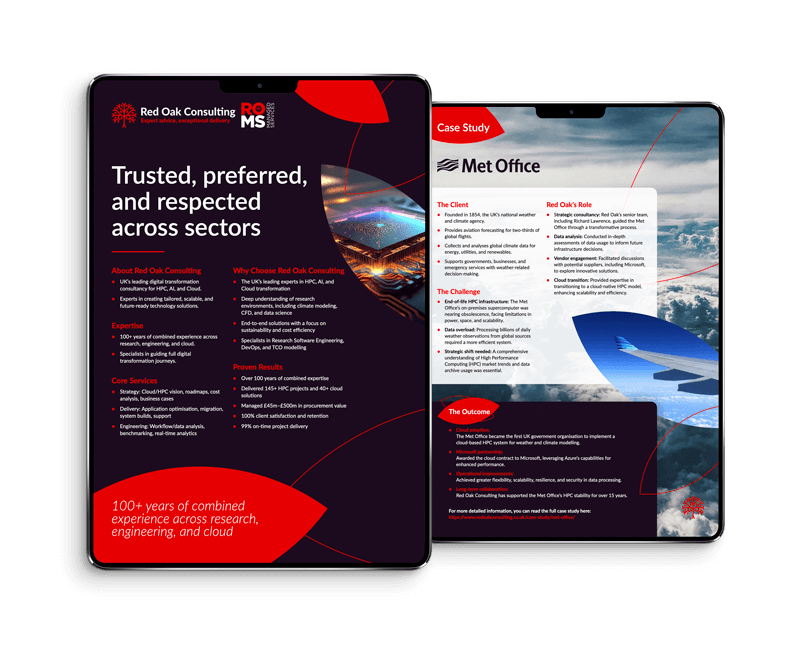
Red Oak’s ROMS model is built exactly around that: cluster management, software expertise, user support, RSE capability and knowledge transfer, all working together.
HPC environments are living systems. They evolve as research and engineering evolve. The support model needs to evolve with them.
Conclusion
High‑Performance Computing sits at the heart of modern research, engineering and AI.
When support is reactive and fragmented, performance suffers. When it’s structured, strategic and proactive, HPC transforms from “that system we hope behaves today” into a genuine accelerator.
HPC Managed Services aren’t about handing responsibility away.
They’re about building capability, protecting investment and enabling long‑term progress.
Because in high‑performance environments, support needs to move at the same pace as innovation, ideally without anyone having to panic‑refresh a dashboard.

Beth Kent
Red Oak Consulting