The Hidden Cost of the Digital Age
Water scarcity is one of the most urgent environmental challenges of the 21st century. Today, half of the world’s population is affected by water stress, and by 2030 the globe will face more than 40% shortfall in freshwater resources.
These are not distant projections; they describe a crisis that is unfolding now, reshaping communities, economies, and ecosystems across the planet.
At the same time, our dependence on digital infrastructure is growing at an unprecedented pace.
Cloud computing, artificial intelligence, streaming, remote work, and data-driven economies are fuelling the rapid expansion of data centres.
Public discussions often focus on their massive energy consumption and carbon footprint. While energy efficiency is critical, it has overshadowed a quieter but equally alarming issue: water.
Data centres are not just power-hungry, they are also water-intensive. In a world where freshwater is becoming increasingly scarce, the question is unavoidable: where do data centres fit in the global water crisis?
Where Does Data Centre Water Go?
The water footprint of a data centre can be divided into two main categories: direct and indirect consumption.
Direct Water Consumption (≈25%)
Direct water use refers to the water consumed on-site to keep the facility running. This includes:
- Cooling systems (the largest share)
- Humidification
- Facility operations
Modern servers generate enormous amounts of heat. To prevent overheating and equipment failure, data centres rely on cooling systems.
In many regions, this means evaporative cooling, where water is used to absorb heat and then released as vapor. In practice, nearly all direct water use in a data centre is for cooling.
Indirect Water Consumption (≈75%)
Indirect consumption is far less visible but much larger. It comes from the water required to generate the electricity that powers data centres, particularly at thermal and nuclear power plants that rely on water for cooling.
According to research referenced in Nature Climate Change (2021)(*), approximately 75% of a data centre’s total water footprint comes from electricity generation, not from the facility itself.
This means that even data centres claiming “low water use” on-site may still have a massive hidden water footprint through the energy they consume.
The Scale of the Problem
The numbers reveal the true magnitude of data centre water use:
- United States (2023):
In 2023, 228 billion gallons of water used by data centres only in US, where 17 billion gallons were direct use, this enormous quantity can cover the water needs of 788 million people.
- AWS (2024): 10.5 billion gallons
- Google (2024): 8.1 billion gallons
- Microsoft (2024): 1.69 billion gallons
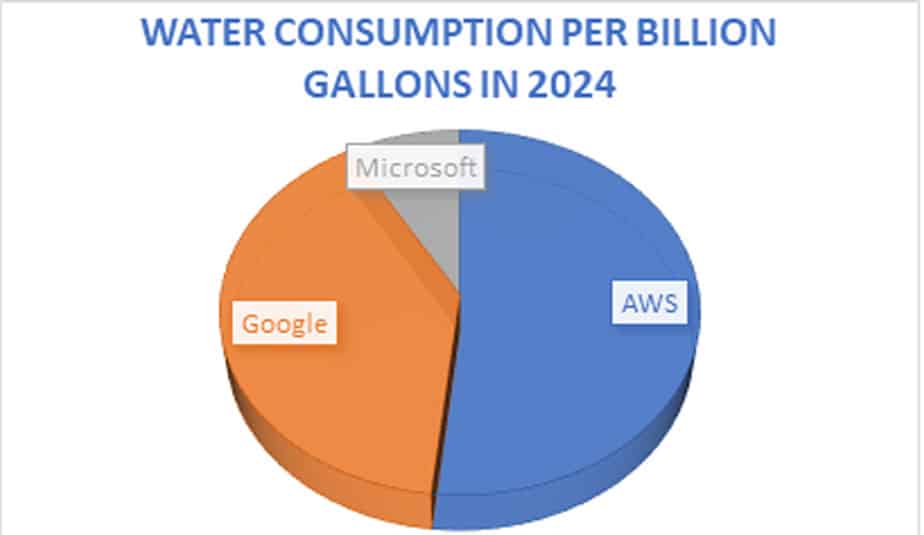
Figure 1 Water consumption in Data Centres per Billion Gallons in 2024
And the trend is accelerating.
Citing Bluefield Research(**), global data centre water consumption grew 6% annually between 2017 and 2022. If this growth continues, total water use could reach: 450 million gallons per day by 2030.
That is the equivalent of 681 Olympic-sized swimming pools of freshwater every single day, just to keep the world’s data centres cool.
When Data Meets Drought: Real-World Examples
The following picture shows the rapid growth of data centres in regions facing high water stress, emphasising the environmental challenges of infrastructure expansion;
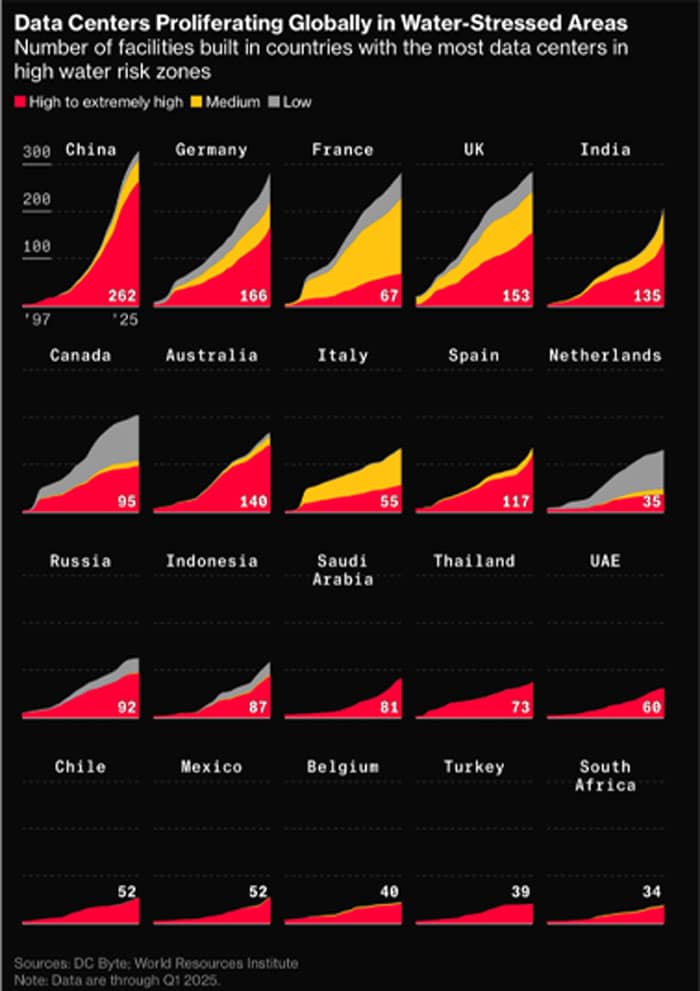
Spain: Data Growth in a Dry Land
Spain is rapidly becoming a major European data centre hub. Yet 75% of the country is already at risk of desertification.
In the Aragon region of northern Spain, Amazon operates three data centres and is planning at least three more.
These facilities are licensed to use: 755,720 cubic meters of water per year (199.6 million gallons). That is enough to irrigate 233 hectares (576 acres) of corn fields.
And this figure does not even include indirect water use from electricity generation, meaning the real impact is significantly higher.
Arizona: Data Centres vs. Drinking Water
The United States hosts the largest number of data centres globally.
Maricopa County, Arizona, is both a fast-growing data centre hub and a region facing extreme drought, according to NOAA (National Oceanic and Atmospheric Administration).
In June 2023, Arizona revoked permits for new homes in the county due to a lack of groundwater. Yet technology expansion continues:
- Meta opened a $1 billion data centre in Mesa (2025)
- Google has one data centre in the area and is building two more
- Microsoft operates two active data centres
Google’s Mesa facility alone has a permit to use: 5.5 million cubic meters of water per year, the same amount used by 23,000 Arizonans.
Although Google plans to rely more on air cooling to reduce usage, the tension between community water needs and digital infrastructure remains stark.
Why This Matters
Every digital action; sending emails, streaming videos, training AI models, storing data, has a physical cost. Behind every cloud service is a building full of servers that must be cooled, powered, and maintained.
Any data-centre-related activity directly means water consumption. As climate change increases drought frequency and reduces freshwater availability, data centres are becoming part of a global resource conflict.
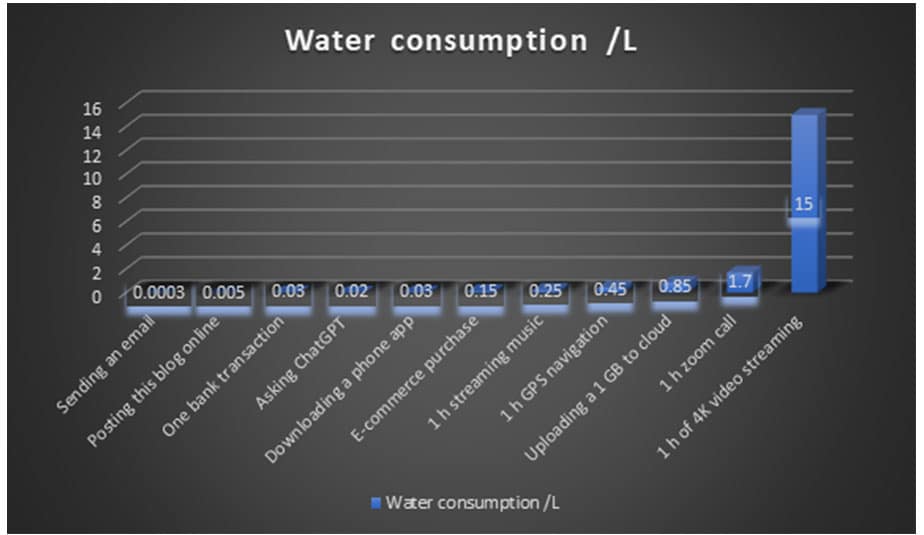
Figure 2 Data from Sunbird and the American Public Power Association.(***)
Industry Response: Moving Toward Water-Positive Data Centres
The good news is that the industry is beginning to act. Major operators including Amazon Web Services, Microsoft, Google, and Meta have pledged to become “water positive” by 2030, meaning they aim to restore more water than they consume.
Corporate Commitments
- Amazon: Plans to replenish 3.9 billion litres of water annually through restoration and community water projects.
- Microsoft: had committed to reducing water used in evaporative cooling by 95% in its global data centres.
These goals mark a shift from simple efficiency to net-positive water stewardship.
The Rise of Green Data Centres
Sustainability is no longer optional. “Green data centres” are designed to minimise both energy and water use through:
- Air-based and liquid-free cooling
- Closed-loop water systems
- Recycled or non-potable water
- On-site renewable energy
- AI-driven cooling optimisation
Environmental performance is often measured using metrics such as Power Usage Effectiveness (PUE) and Water Usage Effectiveness (WUE) to track how efficiently a facility uses resources. The future of data infrastructure must be not just low-carbon, but low-water.
Conclusion
The digital world may feel weightless, but it rests on a very real and very fragile resource: water. As global freshwater shortages worsen, the water footprint of data centres can no longer be ignored.
Their growth must be balanced with responsible design, transparent reporting, and meaningful conservation efforts.
The challenge ahead is clear: if data is everything in modern world, water is the lifeblood of the planet. Protecting one must never come at the cost of the other.

Khaled Mahjoubi
Senior HPC Managed Service Specialist
Red Oak Consulting